


Adhesives on demand: Detachable joints for thin CRC components with magnesium oxychloride cement
Using digital manufacturing techniques, carbon concrete can achieve a high degree of prefabrication and produce thin-walled, more material-efficient components, making it ideally suited for modular construction methods. For the widespread use of carbon concrete in construction practice, joining techniques that ensure a force-fit bond between prefabricated components are therefore necessary. In addition to mechanical fasteners, such as anchors and bolts, epoxy resin adhesives and mineral-based mortar adhesives are primarily used for this purpose. A key challenge for all systems lies in the non-destructive removal of the connections at the end of their service life.
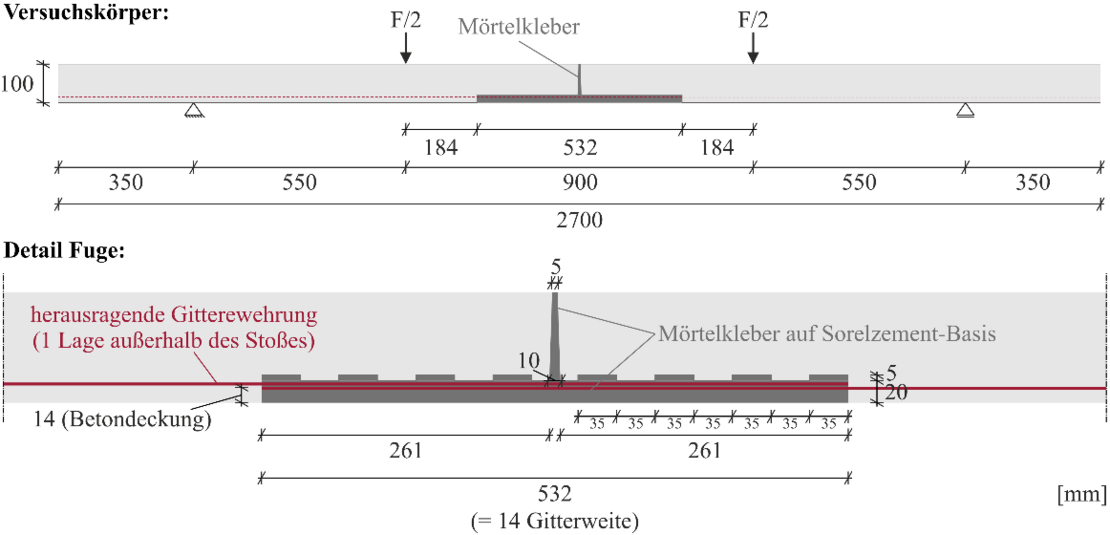
In this Seed Fund project, we are investigating the use of alternative cements as dissolvable adhesives for carbon concrete components. The corrosion resistance of carbon reinforcement enables new material combinations in this context that are not feasible in conventional reinforced concrete. For the first time, Sorel cement—a chloride-containing magnesia cement—is being investigated as a rapid-setting mineral adhesive for carbon concrete. In addition, its selective dissolution in the adhesive joint through an acidic environment is being tested—based on the “debonding on demand” principle.
Team

01062 Dresden (Germany)

52074 Aachen (Germany)
Veröffentlichungen | Publications
Scheel, J.; Dilkin, E.; Liebscher, M.; Classen, M. (2026) Sorelzement als schaltbares Bindemittel für lösbare Fertigteilverbindungen und Bewehrungsstöße im Carbonbetonbau in: Beton- und Stahlbetonbau – DOI https://doi.org/10.1002/best.70206