



Bridges fascinate us all: they span valleys, connect banks, and open up new paths. Whether a delicate pedestrian bridge, an elegant arch construction, or a massive truss structure—every bridge shows how clever design and well-thought-out structure work together. It's not just about stability, but also about using materials sensibly—in other words, building in the most resource-efficient way possible and using as little material as possible.
We encounter different supporting structures in nature and technology around us: beams, arches, trusses, and truss structures carry loads in very different ways. For children, this is an exciting introduction to the interplay of form, function, and material—and this is exactly where our hands-on Junior Bridge Builder program comes in.
At the beginning of the event, we watch a short film together. Based on the well-known Löwendahn film “Peter will über den Bach” (Peter wants to cross the stream), the children discover how bridges work: How are forces distributed? Why is a structure stable? And why can a clever design often get by with little material?
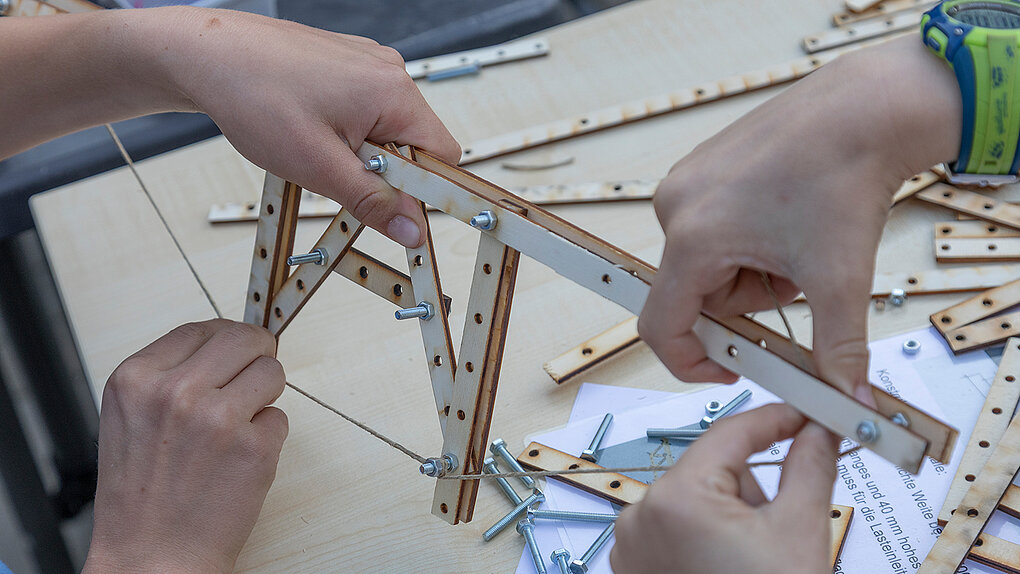
Afterwards, we move from watching to doing: The children design and build their own bridge models. Using perforated wooden pieces, screws, and string, they create small constructions to test how stable structures can be built with as little material as possible. They playfully explore which shapes are particularly load-bearing and how building with minimal materials can still function reliably.
The highlight comes with the load test: using a simple testing machine, we test together how much weight the bridges can bear. This demonstrates how resource-efficient constructions work – and that clever ideas are often more important than large quantities of material.
Junior Bridge Builder conveys the basics of building culture, technology, and sustainable thinking in a clear and practical way – understandable, tangible, and with lots of fun experimenting.
Suitable for children aged 6 and up.
About the exhibition:
“Rethinking Bridges: Living Space, Urban Space, Open Space” (January 23 to February 26) not only examines the topic of bridges from an infrastructural perspective, but also highlights urban planning and social aspects. The exhibition, conceived by the Institute for Solid Construction at TU Dresden under the direction of Prof. Steffen Marx, uses national and international examples to show how bridges can be positively integrated into the cityscape, nature, and thus also into the living environment of their users. The historical change in bridge visions and student designs for the reconstruction of Dresden's Carola Bridge are also presented.